So a few months back I wrote a post comparing Devil Survivor to Ni No Kuni. In said post I essentially sung the praises of Devil Survivor (and denounced Ni No Kuni), but the thing is, at the time I had only played about 8 hours of the game. Since then I have played about 20 hours more of the game, and being just about done, I wanted to to give a more complete impressions on the game. Needless to say, that is where this post comes in. I feel I should note that my opinion of each game (and which is superior) has not changed at all, but there is certainly a lot more to say about Devil Survivor now.
So before I go on, let's recap what I said in the aforementioned post. The long and short of it is that Devil Survivor has very deep gameplay. It has several mechanics all designed around the concept of building a cohesive team of demons with a large degree of customization. Said mechanics are also introduced at a pretty snappy pace, you get just enough time to figure out each mechanic, and it doesn't take forever to introduce them all. That customization isn't that easy to achieve though, as it typically requires demon fusion, and thus a lot of thought has to go into how best to achieve the desired results. The result is some pretty cool SRPG combat. 20 extra hours of play hasn't changed my opinion of this aspect of the game one bit. If anything, it gets even deeper as you go. Even without adding more mechanics, just the number of demons and abilities you get access to continually adds to the depth of the demon customization.

Aside from the gameplay, one big thing that I wanted to point out about Devil Survivor is it's story. While it's presentation is very simplistic and it starts off just like any other JRPG, Devil Survivor actually has a surprisingly striking narrative. Three teenagers randomly get the power to fight demons and save the world, but they are also trapped in an area of Japan with no power and no cellphone service, with thousands of other people (most of whom cannot fight said demons). As the days go by the people trapped in the "Yamanote Circle" become more desperate and dejected, the demons get more aggressive, and unbeknownst to most, some unknown disaster is looming on all of them. What's so impressive about all this though is just the way each person react to it all. Their responses feels very realistic, and seeing the way each person handles the situation creates some pretty powerful moments. There is something very profound about the way that, in the middle of this battle against demons, mankind is still their own biggest adversary. Amidst all this, the decisions that the player can choose also really makes one think about the moral stance they want to take on things. It's all a very interesting situation, and I didn't expect it in a game with such a by the book opening.
Unfortunately, things are not all rosy in Devil Survivor town however. The game suffers a lot in the area of difficulty. Of course there isn't anything wrong with a hard game, but the way in which Devil Survivor gets it's difficulty is somewhat problematic. Personally I really enjoy the battle system, I spend time fighting battles just because they are fun, and as a result am almost always sitting at about as high a level as you can be at any one point in time. Given that, I found fights which are just your team versus a bunch of demons to be pretty simple across the board. Problems arise in two different situations however. Firstly, there are several fights in which you have to protect NPCs. Second, boss fights. Granted, there is a difficulty option, but you can only choose your difficulty at the beginning of the game. I'm not about to start a new game because I'm stuck on a hard fight 25 hours in. It also doesn't help that there is no way to skip dialogue, so every time you fail a mission you are forced to sit through several minutes of dialogue before trying again (often including dialogue options, too). But let's get to the two aforementioned issues.

Now when i say there are fights in which you have to protect NPCs, I'm sure every game out there knows instantly where I'm coming from. Everyone has played at least one game in which you have to protect some flimsy, incompetent NPC, or suffer a game over. Devil Survivor is little different. Killing the enemies is no problem, but making them not kill the NPC is a different story. What's worse is that said NPCs invariably start a long way from your party. This means that the challenge in this mission basically becomes nothing but "hope the NPCs don't die before you can get to them". This results in some pretty frustrating losses, because when you fail it feels like you got unlucky and/or there was nothing you could do better. It doesn't help that the NPCs rarely go where you would like, but this does make some sense in the narrative at least. Your party summons demons, it makes sense that civilians would be confused and perhaps scared of you. It's also kind of neat narrative-wise that you spend so much time trying to save other people, but none of this makes their incompetence any more tolerable. The final nail in this particular coffin is just the frequency with which you encounter this kind of mission. At a guess I would say that somewhere in the vicinity of 20-25% of missions involve someone from their own stupidity.
Which leaves boss fights. Luckily there aren't anywhere near as many of these. It sounds kind of weird to say that boss fights are too hard, seeing as of all the fights in a game bosses should be hard. Where Devil Survivor goes wrong is just the fact that the bosses are so much harder than everything else you fight. One would expect that if you are completely and utterly wiping the floor with every other enemy you encounter, you should at least stand some chance against a boss. You would be wrong though. There isn't a single boss that didn't give me huge amounts of trouble, despite being ridiculously over leveled. The problem here is that, if you aren't capable of at least putting up a good fight against a boss that you have to beat to advance the story, then the game shouldn't allow you to get to that point. The fights leading up to that boss should be challenging enough to prepare you for it. If you are struggling against the rabble, you know something is wrong. If you breeze through the rabble, then the boss becomes an impassable wall which you smack head first into. It's called a difficulty curve for a reason. It's supposed to be a curve. Devil Survivor's bosses provide some of the biggest difficulty spikes I have ever experienced. On a slight side note though, I did like how in the case of one of the harder bosses, the game really drives home the fact that they use fire long before you ever face them. It gives you a ton of time to think ahead and prepare your team accordingly. I still got slaughtered when I fought him though.

Ultimately, Devil Survivor is still a very fun game. It gives me all the things I want in a game, and I'm very glad to have played it. It has convinced me more than ever that I really need to just dive into the Shin Megami Tensei universe. It's definitely a game with some serious issues though. There aren't a lot of them, but I feel that crushing difficulty is definitely going to get in the way of a lot of peoples' enjoyment of this title in the long run. It's not a game that even pretends to be trying to appeal to anyone but the JRPG fanatics though. Some people are looking for that kind of difficulty. Honestly, I feel like this game is niche enough as it is, so maybe it's ok that it's so hard. It's not a game I ever see myself playing against though.
About a week ago, I heard about this game by the name of Evoland, a really interesting little game spawned from a LudumDare creation. As a game that is both inspired by and a tribute to the like of The Legend of Zelda and Final Fantasy, I was instantly intrigued. It struck me as a very whimsical game that would be just up my alley, and so I picked it up as soon as it came out. I've now played the game to completion, and normally I wouldn't bother making a post about such a small game, but it was interesting enough that I think it's worth talking about.
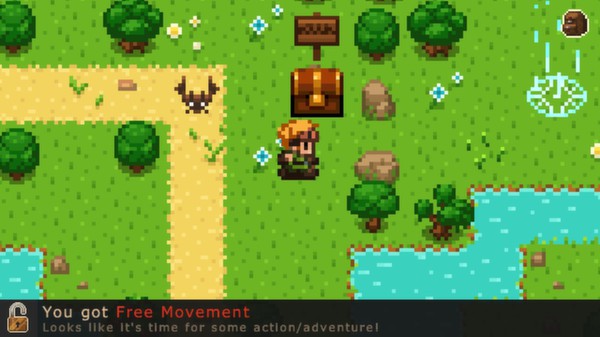
So I already mentioned that Evoland is a sort of tribute to oldschool games, but in truth that's not entirely accurate. While the game is chockfull of references and clearly takes a lot of inspiration from old RPGs, it's more of a tribute to the evolution of games than any particular title or genre. True to it's name, Evoland's biggest claim to fame is the fact that it literally evolves as you progress. Think Upgrade Complete or DLC Quest, but finding your upgrades rather than buying them. When the game starts you are a simple 8-bit character with a Gameboy style black and green color palette. You can't even move left, but as you explore you uncover better colors, sound effects, higher resolutions, menus, and even 3D. As far as the gameplay itself, it begins as a typical top-down adventure style game a la Zelda, but you soon unlock turn based battles as well. One of the things I was most skeptical about going into this game was the fact that it features both this Zelda style adventure mode and the Final Fantasy style Turn Based mode.

Now I'm going to be kind of blunt. Evoland isn't a particularly good game. Gameplay wise, it's pretty mediocre and unsurprisingly suffers a lot from a lack of focus. As nifty as all the references are, it suffers a lot from trying to do too many things, and subsequently having most of them end up disappointing. What's more, I found that there was a very palpable dissonance between the game modes. It felt very strange to get through an adventure mode dungeon with only half a heart remaining, only to have full health upon getting into a random battle on the world map. What's more, the tools you can use in adventure mode have no bearing on turn based combat. Similarly, all the equipment and experience you gather for the turn based combat does nothing for adventure mode. It's especially noticeable because because the game is a mere 3-4 hours short, and so you never experience either mode for more than a couple areas. Stuff like your experience level just doesn't end up mattering at all.
Evoland's turn based combat is ultimately pretty bad. While pretty much every enemy is amusing, the battles are just boring and very shallow. There isn't a battle you can't win by having one character attack every turn and the other heal. It's not even a targeted heal, it just heals both characters. However on the flip side of things, the Zelda mode is actually pretty good. While it's combat isn't that great either, it's got some surprisingly clever puzzles. For example, early on you encounter an impassable block called a "Dimensional Tile". Later on when you return to the area in 3D mode, you realize it was just slightly raised, and 3D you can step right over it. This kind of thing becomes especially important when later areas actually contain crystals you can strike which will switch between 3D and 2D mode. This is unquestionably when the game is at it's best. Being able to experience a couple of areas in both 3D and 2D is pretty cool, and using that as a game mechanic is genius. Mechanically it's not that different than something like the crystal switches you might see in the Zelda series, but aesthetically it has a totally different feel to it.

Unfortunately though, Evoland is a game with nothing to offer but novelty. It's charm and uniqueness is such that the first couple hours are pretty easy to get through without even noticing the gameplay flaws. After the first hour and a half or so though, new things stop showing up and the game goes down hill pretty rapidly. Playing the game for gameplay's sake just isn't entertaining. The game becomes a bit of a chore to get through, and I found myself caring a lot less about completeness. Granted, "completeness" doesn't really seem to be rewarded particularly well. In the early game chests were exciting, as they usually meant some new feature being unlocked. By the end chests are just annoying. You go out of your way to get them, and are literally rewarded with a gold star. What function do they fill? As far as I can tell they are nothing more than a collectible to get because why not. Some chests contain playing cares, which can be used to play Double Twin, a clone of Final Fantasy VIII's fantastic Triple Triad mini game. Even that manages to be a poor imitation of the source material, though.
Which is ultimately what Evoland comes down to. It's an extremely unique game, it's overflowing with charm and fun references to games I love. Despite these things, it's a game that still struggles to be competent in it's own right. It deserves a lot of praise for doing such interesting things, I can't even begin to fathom how they did this (in Flash, no less). The experience of actually playing the game is just quite lacking, even down to frame rate issues, glaring bugs and lack of native controller support. I greatly enjoyed the references, and I think with more time the game could have been great even despite the splitting it's focus. As it stands though, I tend to think 2 hours of novelty and 2 hours of mediocrity is perhaps not worth the $10 price stamp. I'm glad it exists though.
Let me start by saying, shooters are not my thing. There have been a handful of shooters in the past that I quite enjoyed, but every one of them has some secondary function which does it for me. In Borderlands it's the RPG elements. In Uncharted it's the characters, the pacing and the polish. On the short list of shooters I have enjoyed, Bioshock sits right at the top. I didn't like it at first, but I kept going because it's reputation. Before I knew it I was enthralled in this astounding world with an amazing atmosphere and narrative that just wouldn't let go. With that said, I was still a little wary of picking up Bioshock Infinite right away. I didn't follow it's development too closely, and it's still a shooter. The thing is, atmosphere and narrative just aren't things you can really get a sense of unless you are playing the game yourself. However, Steam managed to trick me into buying the game, and so regardless I am here today, having beat the game, to give my impressions.
Once again, Bioshock Infinite proved to be a title that took a while to really get going. I had heard all about this companion Elizabeth, who was supposed to be at the very core of this game. Yet, it took me a good 3 hours to even meet her. That's 1/4 of my total play time. Of course I spent those 3 hours doing other things, and in many ways it made me yearn for the Bioshock of old. lMost of the same concepts return, but are noticeably streamlined. You have access to several abilities (now called vigors), but there isn't much by way of environmental uses for them, and in combat they are mostly just used to stun an enemy or set a trap. 98% of the time it's much easier to just shoot the guy anyways, unless it's one of the "heavy hitters". It's not like normal enemies can do much to you anyways, thanks to the new regenerating shield system.

Shooting in itself is dumbed down too, though. You no longer have access to all your guns, instead going for the groanworthy 2 gun system. You can still upgrade your weapons, but the upgrades seem less interesting and whimsical than the crazy pipes and tubes you tweak your arsenal with in previous games. Plus, what good is it to upgrade your Pistol if your enemies are all going to use shotguns and machine guns? You're kind of forced to also use those weapons. You can can customize your abilities a bit still, through the use of... clothing? Not only does the clothing seem to conspicuously lack a narrative explanation (not something you expect from Bioshock), but it's also kind of boring. With so few gameplay options remaining, the number of things clothing can augment is left pretty lacking. For some reason they seem to fixate a lot on skyline abilities, which I found aren't that plentiful, and even then aren't particularly useful. Ultimately it just seemed to me like the gameplay was purposefully downplayed. My assumption is this is done to keep things simple for the dudebros, and allow players who are looking for a little bit more to focus on everything else in the game.
Thankfully, that is where this game delivers, in spades no less. Immediately upon arriving in Columbia, I was struck by just how different it was from Rapture. Despite knowing it was a city in the sky instead of being underwater, I somehow expected it to feel the same, but I was very wrong. Rapture felt like a very secluded, lonely place. It was just you and the mutant splicers sitting at the bottom of the ocean. Columbia feels vibrant, alive and open. The city is very much intact, full of color, interesting people, and actual character interactions. Even just the feeling of looking out and seeing the clouds adds a much lighter tone to the game. I especially liked how lively the game felt. Columbia is chock full of people, and they all have an interesting story behind them, even if you have to infer it based on what you can see. It's kind of unfortunate that by the end, the scene changes so much. As the action picks up the people get less frequent, more of them want you dead, and the locales are more run down. I suppose it's necessary to create that contrast, to make the later parts of the game feel more dire. Early on Columbia felt like such a unique and fun place though, I can't help but wish I could have had more of that.

Thankfully though, random strangers strewn about the streets of Columbia aren't the only humans you have to interact with. In fact, your player character even has an actual personality now, too. At first I thought it was kind of odd, considering the game never shifts from first person perspective. It felt odd having this voice that was not my own emanating from my character. It didn't help that in the start, Booker DeWitt is basically just a bitter, cynical, emotionally scarred killing machine. He isn't especially interesting, but the way the game leaves out so much information makes you want to learn more, about your character, about this place, and about this girl you are supposed to be finding. Then you find her, and the entire game flips on it's head. Elizabeth is Bioshock Infinite. Booker becomes attached to her, the two characters have good chemistry, and the interaction between the two characters excuses any monotony the first few hours may have held. It's just so hard not to be enthralled by Elizabeth. She is beautifully realized, and easily the most human character I have ever seen in a video game. Her animations are lifelike, her voice is very well done, she is well written, and she's just really easy to like. She undergoes a surprising amount of growth, too. People are calling her a Disney Princess, and I think it's a pretty suiting moniker.
As for the game's actual plot itself, it's a really striking, memorable ordeal. As things start out, everything seems pretty mundane, and I actually thought it was kind of "meh". Columbia is an amazing place, but Zachary Comstock and his ideals are nowhere near as interesting as Andrew Ryan. What I will say though, is that Bioshock Infinite definitely made me think. It's big schtick is the fact that Columbia is an idealistic 1920s city of aristocrats, and as such is full of racists. There is a moment soon after finding Elizabeth that I found very poignant, wherein she innocently asks Booker why the blacks have to use a different bathroom, and he simply replies "that's just how it is". The game doesn't pull any punches in putting these injustices on display. It's shocking, but for the sake of clarity I wouldn't say the game is in itself racist, so much as portraying it's inhabitants as racist. The theme is pretty prevalent throughout the game, and at times actually felt kind of uncomfortable. I don't feel qualified to speak to the themes themselves, but if nothing else I think it's good that the game did such a good job of provoking thought and discussion on the issue.

Racist themes aside, Bioshock Infinite has a very strange plot. As I said, it starts off very mundane, though it ramps up pretty quickly once you find Elizabeth. For a time it actually feels things are going too fast. It seems like things are happening right and left, and yet you aren't actually learning anything new, stuff is just happening. I also felt like Booker's relationship with Elizabeth was kind of all over the place early on. She seems to rapidly go back in forth between trusting him implicitly and not at all. Everything kind of comes to a point after a dramatic scene on an airship. The action slows right down, you find yourself on what is essentially a drawn out fetch quest that overstays it's welcome. Then out of the blue the story takes a complete turn, the action is all uphill from there, but nothing makes any sense any more. Ever. Things get very strange very fast, and they don't go back. The adrenaline starts pumping, serious business time is a go, and it's a very intense sprint to the end, in more ways than one. There are some exceptionally emotional scenes that take place here.
Then comes the ending. On one hand, it's extremely bold, very abstract, and about as weird as everything leading up to it. Part of me wants to say it's amazing and excuses every slow moment, gameplay imperfections and plot oddities leading up to it. Part of me wants to say it's terrible and just way too strange to really be that enjoyable. Ultimately I think after a few days of thinking about it, I'm leaning more towards the first though. If nothing else, it's an ending that promotes a lot of thought and discussion. That on it's own is a major victory. Either way, it's a huge brain twister, and it deserves a ton of respect for tying the narrative of the game together so well, especially when parts of it seemed so spotty prior. I used the word memorable earlier and the ending is most definitely that. I would argue it's even more memorable than the famous Bioshock twist, even if it is way more abstract and confusing.

All in all, Bioshock Infinite is unquestionably an outstanding game. Granted it's gameplay is no great shakes, but in truth that's not what I play Bioshock for. I wanted atmosphere and I got it. It's not Rapture, but Columbia is an extremely interesting place in it's own right. If you are looking for a good mindless shooter, Infinite may not be for you. If you are looking for a thought provoking game with some intense social commentary and deeply emotional moments, then you owe it to yourself to play this game. In truth, I think Bioshock Infinite deserves a spot right next to it's older brother on the list of games every gamer should play. Elizabeth is the standard by which all characters will now be held to. This is her tale in more ways than one. I will truly miss spending time with her, which is strange to say about a digital character, but damn it man, the feels!
It's hard to believe that Starcraft 2 has been out for almost three whole years already. After more than a decade of waiting, I suppose a mere three years wait for the expansion is nothing. Starcraft 2 was released to great fanfare, and as something of a Blizzard fanboy, I counted myself among the excited. While I'm not typically one to play the multiplayer, I very much enjoy the campaigns and watching professionals duke it out. So when the first part of the Starcraft 2 trilogy, Wings of Liberty was released, I was quite eager to see what Jim Raynor had planned this time around. I devoured the campaign and was instantly eager for more. Roughly one week ago as of this writing, the second game, Heart of the Swarm was also released to the masses, and so I thought I would talk about my thoughts on it's campaign.
Before reading on, be aware that this post will contain story spoilers for both Wings of Liberty and Heart of the Swarm.
However, before I talk about Heart of the Swarm, I figured I should say a little about why I enjoyed Wings of Liberty so much. First and foremost, I think a big thing it got right was accessibility. Starcraft 1 and Broodwar were pretty notorious for being pretty difficult to play, both in terms of mechanics, and the actual difficulty of it's campaigns. Wings of Liberty had a wide range of difficulty settings though, meaning anyone who could hold a mouse could experience the entire game, while also providing challenge even to professional Starcraft players. It also had a very wide breadth of experiences. While the base game is always the same, pretty much every mission had you doing something different from every other mission. What's more, with a large amount of customization, there was a lot of room to tackle things using your own style. Tack on to that a great story (both in content and presentation) as well as the typical Blizzard level of polish, and you have what is easily one of the best RTS campaigns of all time.

Now, Heart of the Swarm is a little bit of an odd beast in comparison. That's not to say it's bad, just decidedly different. Being the Zerg portion of the Starcraft 2 story, the game takes a bit of a different approach to things. In particular, upgrades are handled much differently now. Some upgrades can be switched around on a whim in between missions, while others are a single time choice between two evolutionary strands for a type of unit. These choices also provide you with a short mission to demonstrate the effect of each choice beforehand. Ultimately this system feels better, in that you have a lot more control over what your units play like, and you aren't likely to make a choice you regret. Each evolution available to your forces are also pretty awesome, and really lends a Zergy feel to the game, ensuring it doesn't just feel like Wings of Liberty with Zerg units. However on the topic of units, there are several of them that don't perform the same way as in the multiplayer. Now Zerg is a pretty strange race to play, so I can't really blame Blizzard too much for making some concessions for a smoother player experience. It can be pretty disconcerting though, whether you are a single player going to multiplayer for the first time, or the inverse.
Enough about the mundane normal units though. Let's talk about Kerrigan. Unsuspectingly, the Zerg momma plays a large role in Heart of the Swarm, but not just in the story. Past Blizzard RTS games have struggled a lot with how to properly use "Hero" units, but I daresay that they've finally got it near perfect. It plays out a lot like Warcraft 3, but much better. Basically, Kerrigan is present in just about every mission. At the start of the game she is strong, but not amazingly so, and cannot die. However within a few missions you start controlling a proper Zerg base, and then death is less of an issue. If she falls, Kerrigan will simply burrow to the nearest Hatchery and respawn after a short time. This makes it feel like you don't have to obsessively baby sit her for fear of a game over. In addition to this though, she get's significantly stronger over the span of the game. As you complete missions and bonus objectives you will earn "Kerrigan Levels", and unsirprisingly each one increases her stats. Additionally, every so many levels she gets access to a new ability tier, wherein she can equip one of two (later three) abilities, with the ability to change them out between missions. By the end she is an absolute beast, and it really lends a lot to the feeling of progression. This is important, because Kerrigan's power growth is at the center of the plot.

This would be where I would normally talk about the plot, but before I do so, I want to pontificate a bit more about the gameplay. Specifically, mission variety. Wings of Liberty had a lot of it. Each mission is very memorable (whether for better or for worse). Heart of the Swarm really takes it to the next level though, in my opinion. Not only is every level memorable and unique, they are all fun. Wings had some pretty horrendous missions, but I can't say there was a single one in Heart of the Swarm that I disliked. Blizzard has also managed to pump every ounce out of creativity out of the engine on this one. In particular, there were several "infiltration" style missions, which focused on controlling a single unit or group without a base. Traditionally I don't tend to like these types of missions, but Heart of the Swarm did them right. Controlling these special units feels exhilarating, and it makes you really feel like a badass, rather than punishing you for taking a wrong turn like back in the Starcraft 1 days. They even have a mission that feels incredibly like Diablo III, right down to a "boss" who is incredibly reminiscent of Belial. Indeed, there are a few instances of "boss fight" like encounters, which go above and beyond "here's a unit with a ton of health". There are even a few missions with DotA style play involved. All in all the missions are just really enjoyable and have lots of interesting thigns going on. Though they do suffer from the "here's this new unit, build 9999999 of them to win" syndrome a tad, as well as being a bit too easy.
This brings us round to the issue of the story. I say "issue" because to be frank, I'm not a big fan. I vividly remember the end of Wings of Liberty. The whole game lead up to this intense struggle against the Zerg, a battle against all odds with no real indication of what was coming at the end until late into the game. It ended with an incredibly epic standoff that required every bit of your skill even on easier difficulties. In the end somehow against all odds Raynor managed to not only beat back the Zerg, but also get Kerrigan back. This went far beyond the "good guy getting the hero" thing. She was the enemy for two whole games, the big bad. Yet in the background of all of this, there are inklings of a greater threat that never really gets much explanation. As Raynor walks into the sunset of Char, I distinctly recall wanting to play Heart of the Swarm then and there. I wanted to know what newly human Kerrigan would be like, how people would react to her. What would the state of the universe be without the Queen of Blades, this being the first time there was neither her nor the Overmind? How was she supposed to be the one hope against whatever dark force was creating the Zerg/Protoss hybrids if she didn't have her amazing powers any more? After playing Heart of the Swarm I find that I don't have that same insatiable desire to play the next game (Legacy of the Void). I also feel as though Heart of the Swarm was a bit of a let down in regards to all the other questions I had.

The plot doesn't really do one single thing that turns me off, it's more a series of things. First and foremost I think is just the fact that the plot focuses so intently on Kerrigan. While I think this is great for the gameplay, it makes the story less interesting. Throughout the game you never really have much sense of what's going on in the rest of the universe. Perhaps this is some narrative thing that's supposed to mimic how alone Kerrigan is, but that doesn't make me like it. Basically Kerrigan thinks Raynor is dead for most of the game, and so within a few missions she has returned to the swarm, and within a dozen missions she even turns back into the Queen of Blades. Ok so technically she's stronger than before, but she looks the same, which is also lame. To me this just seems like a slap in the face to the entire first game. Yay we saved Kerrigan! Oh wait, no, she's back to being crazy Zerg lady. Well, damn. Just to add insult to injury, Raynor has maybe a dozen lines in the entire game. This is especially painful after he discovers that Kerrigan has been re-Zerged and regathered the Swarm just to save him. He barely has two words for her, and it just feels wrong. I want to hear more from Jim. I know it's the Zerg expansion and it's all about Kerrigan's strive for power, so that she can exact her revenge and all jazz, but that story line isn't as interesting to me. Yea, we know she wants to kill Mengsk, it's not a surprise that the end of the game is storming Korhal just to kill one man. What I want to know is what Jim really has to say.
Enough harping about that particular plot point though. I also mentioned how the game feels secluded and lonely. This touches on what I think is the less noticeable, but perhaps more important contributor to the story's stumbling. Pacing. Heart of the Swarm is a lot more linear than Wings of Liberty. That in itself isn't a big issue, but Wings got some real mileage out of it's open endedness. All throughout Wings there was this sense of impending doom, of something big ramping up. You weren't even really sure what it was, but at the same time you were constantly pooling forces and gathering allies that would eventually help you assault Char. It felt like everything lead up to that glorious last stand, and Heart of the Swarm has none of that. There is no mystery, there is no tension, there is no glorious last stand. Kerrigan spens the entire game just gathering the scattered brood, increasing her power, and on the offensive. It may be the Zerg's way, but it's somehow boring, and somehow feels like less of a concerted effort. It doesn't feel like you are struggling for survival, which isn't helped by the fact that the Hybrid are barely even there. Oh hey yea, there's the hybrid. Shoo, I don't have time for you, I need to go kill Mengsk now.

Perhaps I'm overstating my dislike of the story a bit here though. Kerrigan's storyline itself is... I don't know the word, honestly. It's been a long time since we last controlled her, and back then she was the bad guy. At the time I honestly never thought anything of controlling the bad guy, it just felt like another part of the Starcraft universe unraveling before me. She really does get jerked all over the place. Here in Heart of the Swarm she's finally (mostly) regained her human form, she's briefly reunited with the man she loves, but then she promptly loses it all again. She's forced back to the swarm because it's the best and only way to raise an army. It's unthinkable, but she's also the only one who can do it, and it's necessary if she wants to save Jim (oh yea, and the unvierse, but not until Mengsk is dead). She literally sacrifices everything, and if this game's story does one thing right, it's making you feel the weight of that burden, even if it kind of feels like a dumb decision. Probably the most impressive feat of the story though, is that it has somehow turned the Zerg into the unlikely heroes. You aren't playing the bad guys any more. Kerrigan may be the Queen of Blades again, but her will is entirely her own. As monstrous as the Zerg may be, they are technically now on the side of good, and all indications are that they are the universe's only hope. How that will play out given that the last game in the trilogy focuses on the Protoss... Well, I have no clue.
Aaaaanyways, that's about enough of that. The title of this article says "Thought Dump", and it's quite literally been just that. If you actually read this far, praise be to you. Somehow this post ended up even more rambly and less concise than normal. All told though, I think Heart of the Swarm is a great game. Even with all of the issues I take with the plot, I still think it's a better game than Wings of Liberty just on the merit of the gameplay. It was more fun to play, even if it hasn't left me longing for Legacy of the Void. Though in truth, I'm looking forward to it all the same, not so much for the story, but to see what cool things Blizzard can do with the Protoss (probably my favorite race). Now, I think it's high time I stop typing.
A little while ago I wrote an extensive post detailing all of the things that Ni No Kuni does wrong. The short version is that, it's a good game but is it has terrible compantion AI, terrible pacing, tries to do too many things with it's combat and is very repetitive. The reason I mention this is because of the other game I've been playing recently: Shin Megami Tensei: Devil Survivor Overlocked. While it's a much simpler game with no exploration, no puzzles, simple graphics, almost no animation, etc, I feel like it succeeds in all of the places that Ni No Kuni fails. So I thought I would take some time today to explain my thinking on the matter.
To begin with, let's look at how Devil Survivor works, and why it's similar to Ni No Kuni. Basically, Devil Survivor is what you would get if you mixed a monster collecting game like Pokemon, and a strategy RPG like Fire Emblem. In battle you have up to 4 characters, each of whom leads it's own unit consisting of themselves and two demon companions. The player moves around the grid-based map and engages opponents in battle. Upon entering said battle, the game transitions to a turn-based combat system wherein each member of the two engaging units can use one attack. Beyond this, there is an "extra turn" system, wherein each combatant can earn an extra turn (or cancel the opponent's extra turn) if in this combat phase they hit an opponent with an element they are weak to, score a critical hit, or are just really fast. The way that this is similar to Ni No Kuni is simply in the monster collection aspect of things. While you don't tame demon's, just about every opponent you face in battle can be obtained for your own use. Furthermore, there is a big focus on building a cohesive team by choosing the best demons to place on your team.

Before I get too deep into how the monster systems compare though, I want to talk a bit about the rate at which new mechanics are introduced. As I stated in the other article, Ni No Kuni goes at a slugs pace. Several hours pass between each new mechanic. More to the point though, it feels like the game goes out of it's way to show you why you need this ability before it finally bestows it upon you. The result is basically just frustration all around. Before you get whatever ability, you feel frustrated. It's obvious something is missing and you are being forced to do things the hard way. When you finally do get this new ability, it's a sigh of relief or a "Now why couldn't they have given me this 3 hours ago?". In Contrast, Devil Survivor has a much choppier approach to doling out the goods. Devil Survivor's new mechanics are also all based around the mechanic of improving your demon party through customization. Between the speed and the fact that each mechanic builds upon the last, acquiring some new ability feels way more fulfilling than in Ni No Kuni. The feeling is more along the lines of "Wait, I can do what now? Wow, that's cool, I can't wait to give it a whirl!".
Now then, on to the matter at hand. When it comes to the whole matter of building a team of monsters, there is one main thing that I look for. I want to be able to look at the available allies, easily discern the basic strengths, abilities and weaknesses of each, and with that knowledge compose a team that has the highest possible effectiveness in the most possible situations. I'm a sucker for customization and planning long term. Ni No Kuni has none of this. Customization is minimal, and each monster has way too many factors to consider, making it next to impossible to put together a team that really complements each other as best as possible. You could certainly put together a good team, but it often involves ignoring a monsters elements or astrological sign. On the other hand, Devil Survivor strikes a wonderful balance with it's mechanics, despite having just as many or possibly even more. I suppose you could say it has depth where Ni No Kuni his complexity. It's mechanics complement each other rather than get in each other's way. It's pretty easy to put together a team that wrecks fire monsters, but is really weak against electricity. You could also then solve that by changing out monsters (which you can do in between encounters, even) or even fusing demons together in such a way as to remove weaknesses. Want a healer in this team, but your spellslinger knows no heals? Well, it's not too hard to teach them one, no matter who they are.

These are just some examples of how Devil Survivor does things better. I could go through a ton of specific examples, but I think you get the point. Devil Survivor is all about putting together a team that works well together. Exploiting your enemy's weakness is quite literally a core mechanic. The games goes to great lengths to accommodate your ability to do this by customizing your crew through interesting methods. Ni No Kuni is bogged down by trying to do too many things which get in each others way. In the end of the day a lot of people just end up going with whatever they think is the coolest. Which has merit in it's own I suppose. The fact that you can beat the game using pretty much whatever monsters you want will appeal to some. It's certainly not deep, compelling gameplay though. That about sums the comparison up, actually. Ni No Kuni is all flash but little substance, whereas Devil Survivor is all substance and no flash.