This one is a long time coming. Enslaved is just one of those games that everyone who's played it says is good, and yet very few people end up playing it. It just has this quality that says "you don't have to play me right now, go ahead, wait until I'm cheaper". At least, this was the case for me until I finally picked it up for a measly $5 on PSN. Having now played the game to completion, I thought I would talk a bit about it, if for no other reason than to try and get straight my own opinion of it. You see, Enslaved is a really weird case to me... Allow me to explain.
Enslaved starts out really strong. From the get go you are thrown into the action with no expository introductions. The game opens with a tutorial section that is perhaps a little over done, but considering you are at the time escaping from a crashing airship, I feel as though the action excuses the tutorial a bit. Beyond the first chapter, the game does a good job of never really taking you out of the action too long. The game's story doesn't try to be over complicated, and is told largely through or in parallel to gameplay. What's more, the characters are all quite genuine, and listening to them talk is never annoying or disinteresting. In particular, Andy Serkis does a stellar job as the main character Monkey.

Monkey isn't really your average protagonist. He's a big brute, he's very angry, and everything from his voice acting to his fighting style to the dramatic kill cam the occasionally pops up really hammers home this point. He has pretty good reason to be, to. Early on in the game a girl named Trip fits a slave headband on Monkey, tying his life to hers and forcing him to do her bidding. She is terrified of Monkey, but she also realizes that he is her only hope to get home. What I found really interesting about this though, is that it very quickly becomes unclear who is the real master here. Monkey may have to do what Trip commands, but at the same time Monkey has no qualms telling Trip what to do. In fact, giving Trip orders is a somewhat big part of the gameplay. It's not even annoying, like most escorting tends to be. Seeing how the two characters interact in such a strange, stressful situation is pretty cool, even if where it all leads is fairly predictable.
Unfortunately, that's kind of the story of Enslaved I feel. On the surface everything looks and feels pretty stellar. The game actually reminds me a lot of Uncharted, which is pretty high praise. The graphics are superb and colorful, the gameplay does a good job of mixing combat, climbing and puzzles. Even the way Monkey runs around feels similar to controlling Drake. Everything is really well polished and the presentation is excellent. And yet... The game feels lacking somehow. Like they were trying to paint this beautiful picture, and they did, except instead of painting it on canvas they were painting on printer paper. Sure what's there is a work of art, but what's underneath isn't so great, and it drags down the quality as a whole.

None of the issues behind Enslaved are massive, thankfully. Most of it comes down to minor annoyances. The camera is wonky here, jumping from this pipe to that pipe is weirdly picky, there are a few too many platforming sections, the few puzzles in the game, are tedious and not very rewarding, the game feels like it wasn't designed with regenerating health in mind (granted, it's an optional upgrade) etc. Probably the biggest complaint is the combat. There isn't as much of it as you might think, but what's there is pretty simplistic. You just kind of beat on things until they die, and it's way too easy up until about 2/3 of the way through the game. At that point you have to start using your abilities a little more wisely, but combat transitions straight from mindless to irritating. Enemies can decide they want to be blocking or start attacking you at seemingly any time and there isn't really anything you can do about it. Combat just felt tedious, and considering how well Monkey's rage is conveyed, you would think smashing mechs would be more fun. There are a couple hours in the middle where the game really drags, too.
I suppose what I'm trying to say here is that, Enslaved is definitely an impressive game, I enjoyed playing it. It's a much better experience than a game, though. It's really weird to me, to see a game with so much polish have so many little design issues. One would think that part of polishing the game would be also tweaking the design, but the issues are there none the less. Most of them are pretty easily overlooked, but they come up often enough that it feels like there's always something to be annoyed at. It's pretty common to see a game with lots of potential end up being mediocre, but Enslaved is perhaps the first game I've seen that is mediocre at it's core, but polished so heavily that it ended up being pretty darn good. If you are more willing to overlook gameplay flaws (and I'm almost positive that you are) Enslaved is definitely worth checking out.
As I type this, Awesome Games Done Quick 2014 is just wrapping up. What is Awesome Games Done Quick you ask? Well it's a week-long speedrunning marathon for charity. Games Done Quick events have been been going on for a few years now, and they have been growing pretty rapidly each time. Three years ago a handful of guys in a basement raised $10 000. This time around a crew of 500+ people rented out a hotel for a week and raised $1 000 000 for the Prevent Cancer Foundation. The scale of these events are amazing, they are practically a mini-convention at this point, and obviously $1 000 000 for charity is incredible.
So perhaps you are also wondering what exactly speedrunning is. It's pretty self explanatory, but it essentially entails playing a video game from start to finish as quickly as possible. It sounds simple, but in practice it means extremely skilled players with a lot of knowledge about their chosen game, and a plethora of tricks and glitches that make the game do things you never thought it could do. It's really entertaining to see such high level play, and the way some of the glitches work is fascinating, especially if you are familiar with how games are made or know something about programming.
I make this post for two reasons, but essentially it's just because Games Done Quick events are amazing. Generating so many donations for charity is hugely worthwhile, and it's super entertaining to see such a wide variety of games get ripped apart. Marathons tend to be especially entertaining, because the focus is a little more on showmanship and commentary. So keep an eye out for more of them in the future, Summer Games Done Quick should be happening in about 5-6 months, and there are several smaller events popping up all the time. Keep an eye on gamesdonequick.com and forum.speeddemosarchive.com.
So if you aren't convinced that Games Done Quick is worth watching, watch these clips. In fact watch them anyways, because they are freaking amazing. And all 3 of them happened within about 6 hours.
Super Punch-Out Blindfolded
Super Metroid 4-man race
Goldeneye co-op
If I've piqued your interest, you can find a list of links to every run in the marayhon here, here and here. I haven't seen every run, but here are some highlights beyond the top 3 above, in chronological order:
Jak and Daxter any% by Bonesaw577
I don't really know the game, but it's a good run and Bonesaw is an entertaining guy. Good way to start the marathon.
Viewtiful Joe any% by tminator64
If you know the game, you can probably imagine how entertaining it is played super well and super fast. Unfortunately not many people run it, but it's a really great watch and tminator64 is a charismatic fellow.
Mario 64 0-Stars and Super Mario World by TASBot
Both very short, but demonstrates what's called a Tool Assisted Speedrun. As the name implies, it uses emulators to record a set of inputs which will play the game more perfectly than is possible for a human being. It's pretty impressive, and what they were able to do with Super Mario World is especially impressive.
Yoshi's Island 100% by Tri-hex
This is a fairly long run, but Yoshi's Island is one of the most technically impressive speedruns I have ever seen, and Tri-hex is a great showman with a very fast and chaotic play style. It's worth seeing at least some of it.
Mega Man X 100% race by Caleb Hart and Zewing
This race can't not be bad. These 2 are the top 2 in the world in a very optimized run of a really good game. Just to make things more interesting, they even have a slightly different route through the game.
Castlevania: Symphony of the Night Richter all bosses race by Mecha Richter and Zex
This race was great. SotN is a great game, Richter is really hard and requires an insane amount of skill and practice to play this well, and it was a very close race, too.
Castlevania: Symphony of the Night Alucard any%
This is here mostly just because I love this game and I love this run. romscout is insanely good at it, and this run ended up being really really good.
F-Zero GX Very Hard mode by CGN
This game is really hard, and this guy is really good. To add to the hype they upped the difficulty a bit more by donating to add a couple challenges, and it's just pretty exciting all around. Lots of people consider this one of their favorite runs of the marathon.
Borderlands any% co-op by ProfessorBroman, Teawrex, UberGoose and iMysty
Longish run, but very entertaining I think. Lots of pretty crazy glitches, a couple developers on Skype, the 4 guys have a good repor etc. It's kind of hard to appreciate how crazy it is, but it's a fun time. I find it really interesting how well planned out the run is, considering that it has to be optimized for all 4 players, who often go off and do 4 completely different things.
Mike Tyson's Punch-Out!! Blindfolded by Sinister1
Enough said, really. Playing any game blindfolded is clearly very impressive. This one was a really strong contender for top-3, but there were so many other amazing runs that it barely got edged out.
Super Punch-Out Blindfolded by Zallard1
Obviously similar to Punch-Out, but the whole thing was just a little bit more hype. The game itself has a bit more punch to it, the runner is a bit more animated, it was a little more touch and go, and Mike Tyson isn't around to ruin all the fun. Easily one of the most fun runs I've ever seen.
The Legend of Zelda: Major's Mask any% by ZFG
Majora's Mask is a pretty cool run, and this one went pretty well. I will say however that MM has this problem where you have a ton of setup and not enough payoff - there are long periods of the run where not a lot happens.
The Legend of Zelda: Ocarina of Time all dungeons race by ZFG and Moltov
This race was really really good. It was quite close, and it does a really good job of demonstrating the absurd level to which tricks and glitches open up this game. I recommend this one pretty strongly, though it might be hard to follow both guys if you don't already know a bit about OoT speedruns.
Metroid Prime any% by Miles
Metroid Prime runs are always pretty popular, they've been around for a long time and are just pretty cool on the whole. I'm not a big fan of the runner, but they also had one of the game's developers on Skype which was pretty awesome.
Super Metroid any% 4-man race by Garrison, Krauser, Zoast and Ivan
This is easily one of the top 3 runs of the marathon. Super Metroid is a great speedrun to begin with. Add in a stupid close 4-man race and a couple hundred people in the room, some of the best commentary of the marathon, and the hype is insane. Seriously, if you didn't watch it, go do it.
Metroid Zero Mission hard mode low% by Dragondarch
This run is interesting in a bit different way, being low%. In other words Dragondarch purposefully avoids as many upgrades as possible while also playing on hard mode. This category is more for insane challenge than a fast run, but he pulls it off. A really tense hour+ of really skilled play.
Goldeneye 007 Agent Mode co-op by BassBoost and RWhiteGoose
This run is nuts. First off - these two are both playing the game. Essentially one guy moves and the other shoots. Goldeneye speedrunning is insanely optimized and pretty intense to begin with, and it happens that their time still manages to be really really good. Also Goose is the living embodiment of hype. I suppose it also helps that 7/8 of the games before this one were all really awesome (hint - the last 7 games on this list).
Super Mario 64 one-handed by PEACHES_
Mario 64 is a really impressive run just in general. Peaches isn't as amazing as some other players, and obviously playing one-handed is going to reduce the quality of his play. But like, he's playing one-handed. That's fricking insane.
Chrono Trigger 100% by obdajr
I'm going to be totally honest- don't watch this whole run. It's almost 6 hours long and it's a turn based RPG, so it's kind of hard to really appreciate a lot of the little things going on. Outside of nostalgia it's not the best watch. However this was the last game of the marathon. The last 40-60 minutes or so were pretty cool just in terms of gameplay. Combine that with the fact that there was a mad dash at the end to see if donations could actually hit the 1 million before the end of the run. Both things combined make for a pretty insane end to the marathon, all set to World Revolution. You can watch from about here if you want to see what I mean.
Castlevania: Lords of Shadow is a game that was well received critically, but received a somewhat more mixed reception from gamers. This isn't that surprising, considering the game did a lot of things that were bound to upset fans of the series, including retconning the story, being 3D, being level based, etc. That said, the game was still excellent in a lot of ways. The game's environments were all very well crafted, and showed a lot of imagination. The soundtrack was quite epic, but never got in the way. The story was a pretty interesting re-imagining of the origins of Dracula and the Belmont clan. It's a game with a lot of meat to it, and unsurprisingly, a lot of evil creatures to kill. That's where this post comes in. Today I will be taking a look at what the game's combat did right, and where it could be improved.
So to kick things off, what exactly is the combat like? Well on the surface it looks and feels a lot like God of War. Gabriel Belmont uses his trusty Combat Cross to whip at things from a distance, make combos, send enemies skyward, grab enemies for dramatic finishers, etc. On it's own it's a decent imitation of God of War, but things start getting interesting as you progress in the game and obtain the light and shadow magic. These powers each come with their own magic bar, and can be toggled on at any time to add special effects to your normal attacks, and enable the use of some special abilities. Light magic causes your attacks to heal you, while shadow magic does extra damage to your enemies. These attacks drain your magic, and the main way to restore it is using the game's focus system. As you attack enemies focus is gained, with bigger combos generating it faster. Inactivity will slowly drain focus, while getting hit will reset it entirely. While in a fully focused state, any time an enemy is attacked they will generate magic orbs which can later be absorbed to fill your magic.

This system creates a really interesting dance between keeping yourself alive, keeping your magic reserves high, and actually using your magic. A lot of thought can be put into how best to manage the resources available to you to best make it through a fight. Should you use shadow magic to finish the fight quickly? What if you get hit, then you need to heal yourself and you won't have any focus to refill that magic. When do you build your focus? You can't do that and heal at the same time. When do you switch your magic back on when your focus fills? Do you just fill up your magic, or do you generate extra magic orbs in case you need them later? The issue here is that as interesting as this system is in theory, it has some problems in practice. For one, it just doesn't really fit well with the way the game's combat actually works, and for another it rewards perfect play too well while over-punishing imperfect play. Allow me to explain:
The issues with Castlevania's combat can basically all be boiled down to, it's too easy to get hit. Enemies in Lords of Shadow tend to either appear in large numbers, or have very unpredictable / poorly telegraphed attacks, or some combination therein. Most fights consist of enemies dashing and slashing all over the place, and it gets very hard to react to everything going on. When a particularly nasty attack is incoming they are always telegraphed, but the window to react to it without getting hit is small. In fact the reaction window feels very similar in length to how long you are locked into an animation while attacking or rolling. It seems to me that the intention was that the player should block a lot of these attacks, but this is made needlessly hard by the game's controls. For some reason it was decided that the block button should be the same as the roll button. Holding the button blocks, pressing the button while holding the L-stick causes you to roll in that direction. The issue is that in combat you are constantly using the L-stick to move Gabriel, to direct where he should be attacking, whatever. So attempted blocks frequently instead cause you to roll into the attack you are trying to block. I honestly believe that if rolling had been assigned to the R-stick instead (which is not used for anything ever) a lot of the combat's issues would have been alleviated.

But back to the issue at hand, getting hit is especially bad in Lords of Shadow. Sure, you lose some life, but the implications are much more than that. You basically have three resources in combat: health, focus, and magic. As I described earlier, you use focus to generate magic and you use magic to heal health. The issue is that getting hit drains all three resources simultaneously. Damage reduces health and resets your focus, while also necessitating that you expend magic to heal. In other words, even the smallest of hits can mess up your rhythm entirely. It's incredibly frustrating to constantly be low on magic because the odd stupid attack hits you. On the flip side of things, if you do manage to fill your focus you are typically given an absolutely absurd amount of magic orbs in a short period of time - quite possibly more than you know what to do with. In other words the punishment for being hit is too big, and so is the reward for not being hit. 100% of the rewards are at the top of the scale, and anything but perfect play results in starvation.
With all that said however, I will say that there are merits to both extremes of this system. Low magic situations tend to feel very intense and scrappy - you are literally fighting for your life. If you can't keep your combo going, you won't be able to keep healing yourself. On the flip side, when you fill your focus the reward is pretty big and you feel unbeatable. However that said, I personally would have still preferred if the system had a bit more even of a gradient. For example, perhaps every attack should have a small chance to generate orbs once your focus is greater than 50%, with the chance and volume of orbs increasing as your focus approaches 100%. You still have low magic situations, but you at least get something if you're playing decently. You don't feel like you have to play perfectly to survive, but if you are playing really well the reward is still big. That's my thought anyways. It's fun trying to manage your resources, but you can't exactly manage resources if the game is starving you.
In the end of the day, I think Castlevania: Lords of Shadow is still a very competent title. If it's combat was a little better, the game probably could have been great, though. It will be very interesting to see what changes Lords of Shadow 2 makes when the game comes out in the end of February. If the demo is any indication it seems like the focus system has been forsaken entirely in favor of automatically regenerating magic. I wait with bated breath.
Another year, another Assassin's Creed game. Except somehow it seems that I'm perpetually 2 years behind the curve here. Last year I played Brotherhood, and now a year later I've finally gotten around to playing Revelations. I guess the thing is, I have something of a love/hate relationship with Assassin's Creed. I love climbing about historical settings hitting up all the little icons on my map. However Assassin's Creed games always seem to know just how to frustrate the bejesus out of me. It seems to be the trend that, by the time I'm done with one game I'm frustrated enough that I wait a whole year to play the next one. And of course by that point, the latest title will have come out, thus perpetuating the 2 game backlog. At any rate, I knew going into Revelations that it had not been quite as well received as it's brethren. Now that I have completed the game, here are my own thoughts on the matter.
At first, I was actually pretty pleased with Revelations. One of my biggest complaints with Brotherhood was how restrictive it was. It felt like invisible walls were erected at seemingly random places all over the world. On the other hand, Revelations gives you unfettered access to pretty much the entire map and it's activities within the first hour or so of gameplay. However after playing the game, I feel like Revelations actually went too far the other way, at least for my taste. Personally I feel that the answer is somewhere in the middle. The player should have access to side missions, but they should also be encouraged to progress the story. Rather than throwing all the side content at you at once, I would prefer it be broken up a little bit. In this way it feels like your "reward" for completing all the side quests is moving on with the story, and unlocking the next area of the map. With that said, I actually feel like Brotherhood got the free roaming more right than Revelations, despite my issues with it. I just wish that divisions on the map had been more logical and better communicated.

As far as Revelations' gameplay goes, it is, unsurprisingly, pretty much identical to Brotherhood. At least on the surface. The two big additions are the hook blade and bombs. The hook blade creates some mildly interesting additions to how climbing works, but much of it seems cosmetic. The biggest difference comes in the form of being able to ride ziplines. Ziplines are certainly cool, but they really don't come up very often. Outside story missions, I only used them once or twice. As far as bombs, they seem like a fairly interesting addition, but I honestly just couldn't be bothered. The issue is that the bomb system was just too complicated to be worth it to me. It comes with an entire crafting system, three different categories of bombs, and customized bombs composed of three different parts. It's not wildly complex, I just never felt compelled to play with the system. I would use the odd bomb, but most of the time I felt that I would just rather stick with the mechanics that I had been using for the last 2-3 games.
This issue with the bombs is really indicative of a larger issue with the game on the whole, too. One thing I rather liked about Brotherhood was the way it encouraged you to use a wider array of tools to get the job done. Synchronization goals would have you experiment with different tools, and after exposing you to them the game would later give you situations where said tool would be ideal to use. In contrast, Revelations felt like I could just brute force my way through everything. I don't think I used poison more than once, and I'm pretty sure I never used the smoke bomb, both of which were staples in Brotherhood. I never really saw the need. It felt like I could play through the entire game using nothing but the wrist blade and throwing knives. On top of this, I never hired a single group of Thieves, Mercenaries or Romani. They were there, but they didn't really seem to serve a real purpose. It's like all these things are still in the game just because it doesn't make sense to remove functionality, but they didn't take the time to create situations where they would actually be useful.

This is kind of indicative of my feeling on the game as a whole. It feels like it was rushed. It feels like the shell of a game, like Ubisoft just took the engine from Brotherhood, modeled a new town, and shipped it. It's a good example of how important level design is. Good mechanics are great, but without a world that provides you with the proper challenges, they feel superfluous. That's not to say that Constantinople itself is poorly made, because it's a nice city. It just feels like everything about Revelations is lacking the spirit the previous games had. This is not Ezio's swan song so much as a placeholder to finish Altair's story and hold people over until Assassin's Creed III. This chapter of the story could have been skipped altogether and I don't feel like you would miss it. If anything, after the ending of Brotherhood Revelations is pretty anti-climactic. That's not to say Revelations is a bad game, it's just decent.
Back when Nintendo was just pushing the 3DS onto an unsuspecting world, there was a lot of talk about where the Zelda franchise was going. Skyward Sword had been in the works for a long time, and now Ocarina of Time was getting a pretty major facelift in the form of Ocarina of Time 3D. So naturally people started to wonder, if Ocarina of Time was getting remade, what was next? Many people have rallied long and hard for Majora's Mask, though unfortunately that has not yet come to fruition. However, it didn't take long before Shigeru Miyamoto himself piped up saying he would love to remake A Link to the Past.
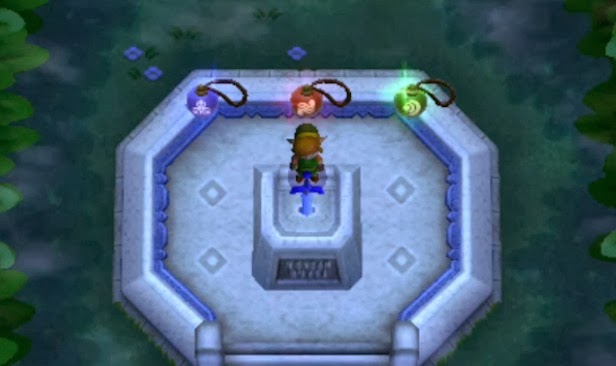
Now I don't know if you know this, but I love me some Link to the Past, so I was pretty hyped about the possibility of a remake of my favorite Zelda game. Then along comes word that A Link Between Worlds was coming, and was a direct sequel to A Link to the Past. I was instantly interested in the game. I didn't even make the connection at the time, that this was our HD remake. We probably aren't going to get an HD Link to the Past. At first this realization made me kind of sad, but I think it's for the best. A Link Between Worlds is probably a better game than an HD Link to the Past could have been. A Link Between Worlds is probably the best Zelda game to date, in fact. Here are some reasons why:
1) The Controls
It wasn't that long ago that I talked a bit about the importance of good controls. They matter a lot. You can tell a game is going to be fun if you pick it up and just controlling your character feels good even without goals or challenges to overcome. A Link Between Worlds has this feel. From minute one you can tell just how responsive Link is to your slightest nudge on the circle pad. He rockets around Hyrule at what seems like a blistering pace, and yet it never feels like he is out of control. He goes where you want, when you want. It seems simple, but it goes a long way when you can't blame stupid deaths on bad controls.
Of course a lot of this precision comes from the simple fact that the 3DS uses the circle pad to control Link's movement. If you think about it, just about every 2D Zelda game has always used the d-pad for character movement. This of course comes with the inherent disadvantage of only being able to handle 8 different directional inputs. So it's not really a big surprise that given the 360 degree movement of the circle pad, A Link Between Worlds feels like a breath of fresh air. Granted there was Four Swords Adventures on the GameCube, and it's controls never really felt quite so awe-inspiring. But we won't talk about that.
2) The "Magic" Meter
One of the things that A Link Between Worlds does best is making little changes that challenge the Zelda norm. Zelda has been around forever, and there are so many mechanics that have just existed from game to game, virtually unchanged in 20+ years. One of the biggest, but subtlest things A Link Between Worlds changes is the way it handles items, and more to the point, ammunition. You don't have to collect bombs or arrows or magic. Every item in the game uses the same resource; a "magic" meter which regenerates at a pretty rapid pace.
This actually has a pretty profound effect on gameplay. At first I was a little dubious, because it means for example, I can only shoot x arrows in y period of time. But gradually I realized that because this meter always refills itself, I had so much more freedom to use items. There is no saving your magic so you can use the Fire Rod to solve puzzles, or holding on to arrows to use them on the boss. You can throw bombs at random enemies all day and it's all good. It makes combat seem a lot more free to be done how you see fit, rather than relying on your sword to do everything. It cleans up the UI nicely, too. It's interesting, because I noticed a similar effect with the more freeform magic system in the Adventure of Link, but for the past 25 years the series has steered away from that.
3) Truly 3D 2D
Link Between Worlds occupies this intriguing space wherein it's a game which is fully rendered in 3D, but it plays like a 2D game, but requires you to think in three dimensions. It's kind of amazing really, that with 3D games having existed for over 15 years, it's a game masquerading as 2D which nails the third dimensional game play better than most "proper" 3D games. Never does a puzzle say " look up, there's a switch on the ceiling you can't see, LOL 3D". Instead it just takes advantage of the fact that in 3D you can so easily render multiple elevations, change perspectives, transition to the backside of a wall, whatever.
The top down view means you can always see exactly what the designers want you to be able to see, but it's still a world where you can merge with and walk around on the walls and smoothly transition between different elevations. I mean sure, we've been pushing blocks onto lower floors for a long time now, but A Link Between Worlds forces you to look at every room in an entirely different way. Every wall has the potential to be a road. The only other game I can think of that has a similar feel to it is Portal. And I think we all know that comparing anything to Portal is pretty glowing praise.
4) The Nostalgia Dance
Let's be real here for a second. I was always going to love a Link Between Worlds. My body is physically unable to dislike a sequel to A Link to the Past just because of my history with the game. So as you can probably imagine, a Link Between Worlds is nostalgia overload for me. The sounds enemies make when you die or when you pick up rupees made me happy. The orchestrated songs from Link to the Past delighted me. The almost identical overworld map gave me all the feels. How many times have I made the journey between Kakariko Village and the Eastern Palace? This time felt little different from when I was 6. It feels like every nook and cranny of A Link Between Worlds was constructed with a nod to fans of A Link to the Past.
What's more impressive though, is that underneath all the similarities, A Link Between Worlds is it's own game. Every iota of this game perfectly maintains the feel of it's predecessor, but it's a brand new experience. The motto of this game may as well be "the same, but different" because it's stamped all over the place. Despite the similarities it still delivers on substance for returning players, and it's still hugely enjoyable for those who are not. The game is great with or without the nostalgia factor, and the fact that Nintendo has managed to strike such a great balance is pretty impressive. Although with that said, I'll never forgive them for changing the way the tempered sword sounds.